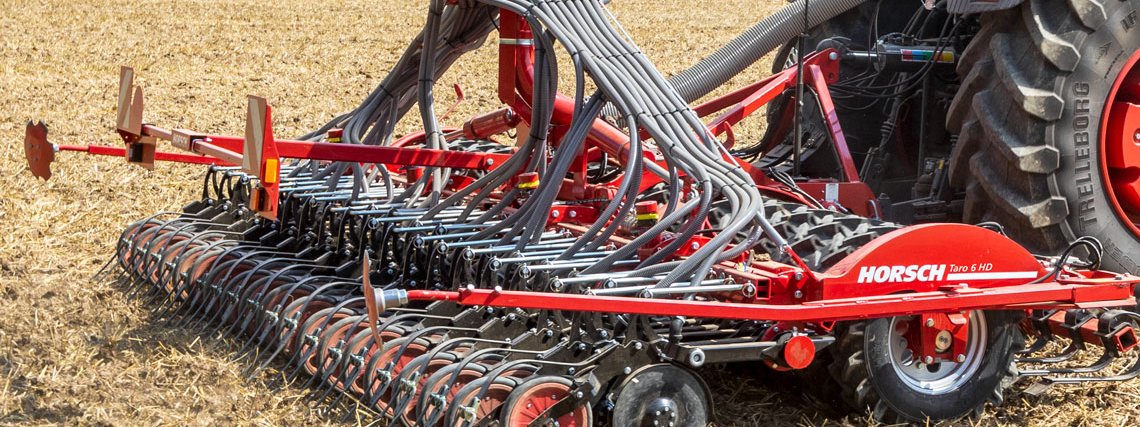
Seedbed preparation in spring 2023 – but how?
“In March, the farmer harnesses the horses“: These lines of an old German nursery rhyme are well known. But this year, they cannot be put into practice because of the weather. Throughout Europe, farmers have to face these two challenges:
- Comparatively low temperatures for the season
- A lot of rainfall and wet fields
The situation grows more and more acute every week and the work in the fields is postponed. Some crops have yet to be sown and this raises the following question: “How can we prepare the fields for sowing?” In this blog article we want to deal with this question. First, we will take a closer look at the challenges.
Challenges in spring 2023
1. Low temperatures
In addition to the optimum embedding for a good root growth and the placement depth, there are numerous other requirements the seed makes on sowing. One of them is the soil temperature.
The earlier you sow, the more days the plant has left for vegetation. However, if the soil is too cold and insolation is too low, sowing early does not have any advantages, for the plant simply does not start to grow. As you can see in the chart, it requires a certain minimum soil temperature to start the germination process.
| Crop | Germination temperature in ° C |
| Maize | 8-10 |
| Oats | 3-5 |
| Barley | 2-4 |
| Wheat | 2-4 |
| Sunflowers white | 15 – 25 |
| Sunflowers black | 7 – 8 |
| Soybeans | 10 |
| Sugar beet | 5 |
However, with the seedbed preparation we can influence the temperatures of the upper soil layer to some degree. If we manage to create a loose and fine-crumbly seedbed, the topsoil aerates much faster and thus also heats up faster.
2. Heavily saturated soils
This year’s phenomenon of high rainfall is well known. In addition to the already abundant winter rainfall, the high and continuing rainfall in spring makes things worse. If we compare the rainfall in March with the multi-year average, we notice that almost 50% more rain fell for example in Regensburg (GER).

© Deutscher Wetterdienst (DWD)
This, of course, refills the water supply in the soil and is an important buffer for the summer – we already saw this last year. But the wet soils entail some big challenges with regard to sowing in spring:
Trafficability and compaction in the subsoil
Beside the optimum seedbed, in wet years the attention also is on the subsoil. Keyword: avoid compaction to not affect gas exchange, root growth and water circuit. Easier said than done. In this case the solution is to wait to avoid structural damages.
Let’s turn to maize, the largest spring crop in Germany and in the same context to organic fertilisation which many farms carry out before sowing. The weight of the efficient application technology exceeds the weight of the sowing technology by far and thus makes even more demands on a good bearing soil.
Massive catch crop populations
After the increased rainfall the soil is to dry off as fast as possible. However, the amount of organic material on the fields is another challenge.
- Frozen off catch crop populations have partly been broken, but additionally shade the soil during the forecasted sunny days.
- Plants that have not frozen off and the volunteer crops of last summer have developed well in the meantime as we can see in the two photos of a field taken on 15th March 2023 and 16th April 2023. It has not yet been possible to drive on the field to carry out any initial measures.


To avoid losing additional valuable vegetation time after this long period of rainfall, a lot of farms schedule an herbicide application to quickly get a grip on catch crops and old weeds.
Cope with the challenges of seedbed preparation
In the first step, our task will be to aerate the topsoil and to crush the catch crops. Only if the topsoil has dried off a little bit, you can drive on the fields with more heavier machines without risking compactions of the subsoil. During the first pass you should not carry out a surface cultivation to avoid smear horizons. These smear layers affect gas exchange, the water circuit and later even the root growth.
Use of disc harrows
To avoid smear layers, discs are a good choice for the first pass. As the discs only penetrate the soil vertically and break the space between the individual discs, they do not create any smear layer. To avoid additional compaction on the headlands, models that turn on the packer are advantageous.


Use of knife rollers
If there is a lot of organic material on the surface that shades the area and prevents drying off, it may make sense to crush it in advance and encourage the drying effect. As opposed to a mulch tool which requires considerably more fuel and time, the knife roller tears open the soil surface additionally.


Use of narrower tine points
Another option is to work downwards step by step with a tine tool. With more passages the soil can aerate better. If you work too deeply at the first time, you take large clods to the surface which will cause problems with regard to the following population management.
Tine tools with narrower points and a tighter tine spacing are clearly at an advantage.
With or without a packer and which packer?
The rougher the structure is after cultivation and the less you consolidate, the more water evaporates and the faster the soil dries off. For sensitive soils with a high clay content, it may be advantageous to cultivate without consolidation. An example is our Finer: for such conditions you can change between packer and support wheels.
After the trafficability has been improved and the catch crops have been crushed, we are back to the traditional seedbed preparation. We already know these requirements from the other two blog articles about seedbed preparation: Seedbed preparation – for an optimum embedding of the seed
To create a fine-crumbly and consolidated seed horizon, seedbed preparation with a tool including a packer is indispensable.

As always, the choice of the right packer depends on the site: What is the crumbling behaviour of my soil, is it prone to tight lodging, is the cohesion low or can it carry loads only to a limited extent? Moreover, the previous cultivation depth is a key criterion when it comes to choosing a packer.
To summarise:
Difficult conditions like this year also bring about bigger challenges. Those who wait too long, give away vegetation time. Those who go into the field too early and in wet conditions, risk compaction and, thus, yield losses. If the right technology is used correctly, one more pass can be the more economic solution. Regardless of the strategy, wide-base tyres with little air pressure have top priority in wet conditions.
(Blogpost: Soil conservation vs. heavy machines (I)).
In addition, light tractors and trailed mounted implements are advantageous.